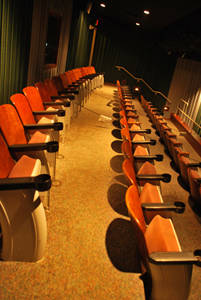
Palace Theatre, Vinton (06-00793).
Statewide Survey of Historic Movie Theaters
Documenting movie theaters throughout the state of Iowa is not a simple as one might think. The Preserve America project's goals included intensive level survey and evaluation of at least 200 movie theaters built before 1975. Initial research identified 472 theaters meriting field investigation and 118 already demolished. To narrow that list down, theaters were removed from consideration if they were already listed on the National Register of Historic Places, surveyed in the last 15 years, or were verified to be nonextant or having little integrity. Priority was also given to areas of the state that are underrepresented in the Iowa Site Inventory, such as western Iowa and the rural communities northeast Iowa. In the end, 221 properties were visited during the summer and fall of 2009, resulting in the intensive level survey of 207 theaters (109 previously not found in SHPO files).
The results of the statewide survey, including research and fieldwork, are presented in a National Register Multiple Property Documentation Form and on this website. The original survey forms and photographs will be integrated into the Iowa Site Inventory at the State Historic Preservation Office. As part of the Preserve America grant, one of the surveyed movie theaters is being nominated to the National Register of Historic Places. The Sioux Theater in Sioux Rapids was chosen due to its unique architecture, incredible integrity, and its preservation-minded owners, the Sioux Rapids Area Historical Association.
National Register Documents
Download the full Multiple Property Documentation Form  (781.7 KB)
Multiple Property Documentation Form
The Multiple Property Documentation Form (MPDF) facilitates nominating related historic properties to the National Register of Historic Places. The MPDF organizes associated themes, trends, and patterns of history into historic contexts and defines the property types representing those historic contexts. It streamlines the evaluation of individual properties by comparing them with resources sharing similar physical characteristics and historic associations.
Historic Context
The MPDF prepared for the statewide movie theater survey presents a historic context entitled “Historic Development of Iowa Movie Theaters: 1880 – 1975.” Within the historic context are the following subcontexts:
- “Historic Development of Public Entertainment Venues in Late Nineteenth and Early Twentieth Centuries in Iowa: 1880 – 1917”
- “Rise of the Motion Picture: 1900 – 1930”
- “Statewide Impact of the Era of Centralization and Domination of Movie Theater Chains: 1920 – 1948”
- “Movie Theater Development in Iowa in the Great Depression and the War Years: 1930 – 1946”
- “Iowa Movie Theaters in the Post-World War II Period and Era of Suburbanization: 1946 – 1975”
- “Evolution of Movie Theater Design in Iowa: 1900 – 1975”
Property Types
There are seven property types associated with the historic context. The first five property types are associated with live performing arts in addition to showing movies; the final two property types are associated exclusively with movies.
- Community Halls, including second floor spaces in existing buildings
- Opera House Movie Theaters
- Conversion Movie Theaters
- Commercial Block Downtown and Neighborhood Movie Houses
- Movie Palaces
- Drive-in Theaters
- Multiplex Theaters
In the MPDF, each of these property types are described, including an explanation of their significance and requirements for listing the properties on the National Register.
Sioux Theatre, Sioux Rapids
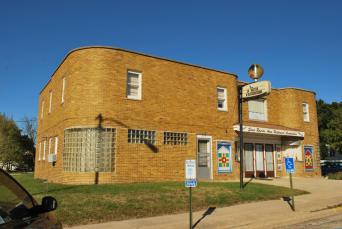
Sioux Theatre
218 Main St
Sioux Rapids, IA
Built 1946
Download the National Register nomination (7.03 MB)
National Register Nomination:
Sioux Theatre, Sioux Rapids
Constructed in 1946, the Sioux Theatre is significant at the local level in the areas of Entertainment/Recreation, Commerce, and Architecture. It meets the registration requirements for the commercial Block Downtown and Neighborhood Movie Houses property type, as defined in the MPDF. As the only movie theater within an 18-mile radius of Sioux Rapids, the Sioux Theatre played an important role as an entertainment venue and in the resumption of commercial development in Sioux Rapids following the Great Depression and World War II.
Wetherell and Harrison, a Des Moines architectural firm noted for their theater architecture, designed the Sioux Theatre. The building's streamlined design reflects the early years of a post-war transition away from Art Moderne within the American Modern Movement. The building's exterior represents the Art Moderne style through its horizontality, curved walls, chrome detailing, and buff brick façade. Its interior presents an unusual arrangement of expected functional spaces, including an entrance lobby with a ticket booth accessible to the exterior and interior, a large concession area, lounge, and a curvilinear secondary lobby leading to restrooms, a crying room, and the auditorium. With seating for 404 patrons, the Sioux Theatre featured the latest amenities, including a 13.5 by 18-foot stereo silver screen with invisible seams, floor sloping for maximum visibility from each seat, sound-dampening features, and comfortable seats with ample legroom.
The Sioux Theatre was owned and operated by Don and Edna (Collins Rector) Gran from 1946 to around 1960. They lived in the building's large, second-floor residential apartment. Active in the Independent Operators Association, the Grans had previously operated the Star Theater in Sioux Rapids and the Avery Theater in Garner. The theater closed in 1976. The Sioux Rapids Area Historical Society took ownership in 1985 and continues to care for the building, which now serves as the home of their museum.