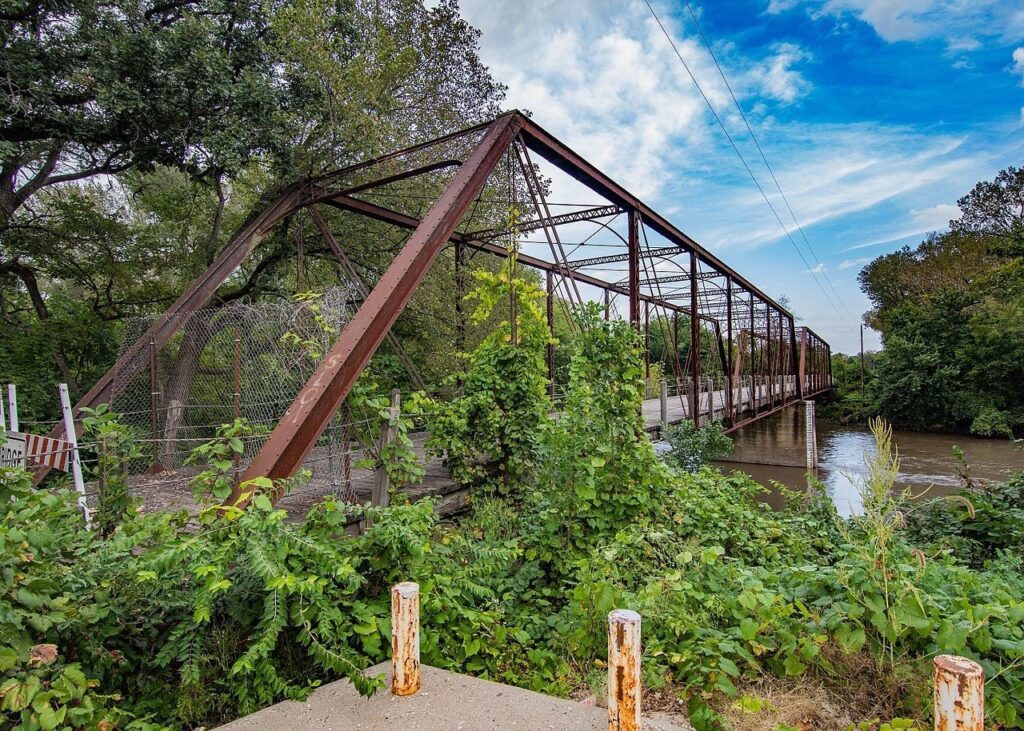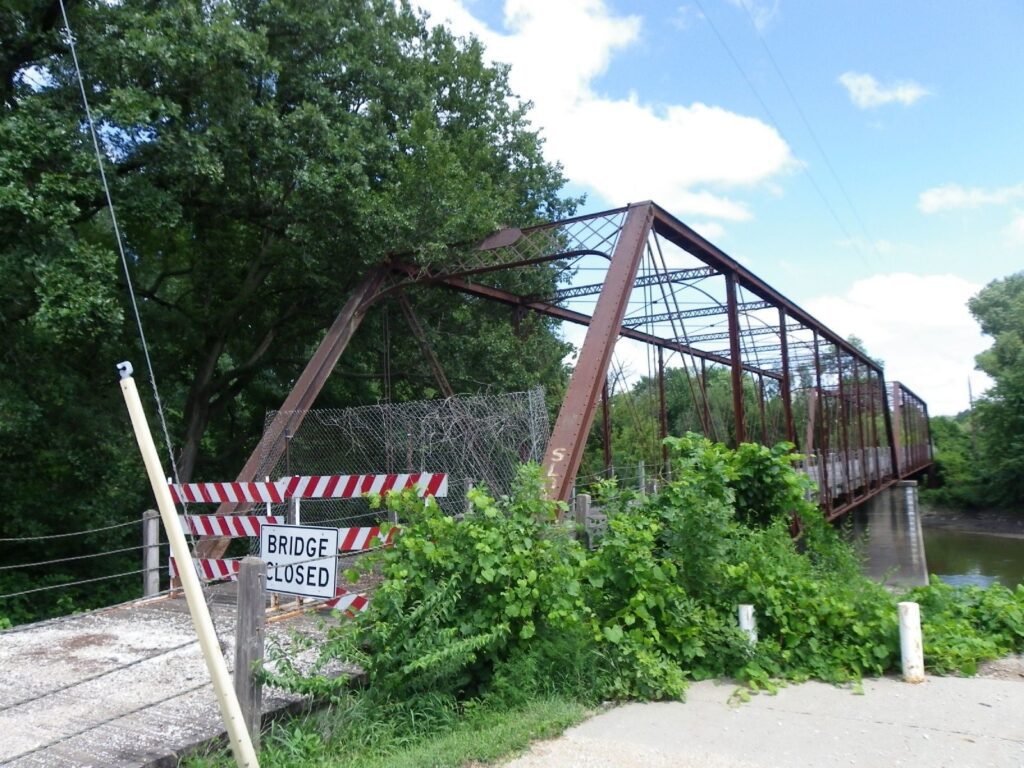
This two-span wrought iron truss bridge spanning the North Raccoon River on the east edge of Adel was fabricated by the King Iron Bridge and Manufacturing Company of Cleveland Ohio. The bridge served as the primary river crossing into Adel from the time it was erected in 1882 until 1932 when the U.S. Highway 6 bridge was completed not far to the south. In its history the crossing was a part of the River to River Road, the Detroit Lincoln Denver Highway, US 32 and for the first few months, US 6. After 1932, the bridge continued to serve secondary road traffic until 2000 when it was closed due to structural concerns.
The pin-connected Pratt through truss like the Adel bridge was a common bridge type in Iowa from the 1880s until the establishment of state bridge standards in 1913. Even so the Adel Wagon Bridge is one of the oldest remaining Pratt trusses in Iowa and noteworthy for its two-span configuration.
The bridge was placed on the National Register of Historic Places in 1998.
In late 2002, when demolition of the bridge was initially being considered, a citizen group formed to work toward saving the historic bridge in its original location. Contributions were solicited and funds from sales of promotional items were collected to pay for engineering studies. The studies identified several structural concerns to be addressed before the bridge could be serviceable including strengthening the main truss members and queen-post assemblies and the replacement of the timber assembly which supports the timber flooring.
The City of Adel and Dallas County, co-owners of the bridge, have no definitive plans at present for the preservation of the bridge. In the meantime, the support piers are exposed to high water and erosion from annual floods and no maintenance has been performed on the bridge since it was closed in 2000. In that capacity, the bridge will continue to deteriorate.
The most viable solution identified by those who support the preservation of the bridge is moving it to a local park. Converting the bridge for pedestrian use at its present location is not feasible as an old railroad bridge slightly to the south has already been so adapted as part of the Raccoon River Bike Trail.