News
Stay informed and engaged with Preservation Iowa’s latest news, events, and initiatives dedicated to preserving the state’s historic places and promoting community revitalization. From advocacy efforts that shape state and local policies to innovative programs supporting historic preservation and economic development, Preservation Iowa is committed to making Iowa’s history a vibrant part of its future.
Follow Preservation Iowa on Facebook for the latest updates on preservation efforts, events, announcements, and news. Become a member to receive our newsletter and preservation alerts directly in your inbox.
Check out Section 106 in the News for information on Section 106 of the National Historic Preservation Act and why it is currently a hot topic of discussion.
If you have preservation-related news or advocacy items to share, please reach out via email at info@preservationiowa.org or through our Connect & Contact Us page.
PRESERVATION NEWS FROM ACROSS THE STATE AND NATION

IEDA Receives $750,000 in Federal Funding for Rural Historic Preservation The Iowa Economic Development Authority (IEDA) has received a $750,000 award from the National Park Service’s (NPS) Paul Bruhn Historic Revitalization Grant Program to support another round of Iowa Rural Heritage Revitalization Grants. The award is part of nearly $17 million in federal grants announced by NPS last week to rehabilitate historic properties and foster economic development in rural communities. The next round of Iowa Rural Heritage Revitalization Grants will open in December, with applications due in March 2027. Eligible applicants: Iowa-based nonprofit organizations, units of local or county government and federally recognized tribal councils. Eligible projects: Properties in rural areas owned by the applicant at the time of application. Eligible properties include buildings, structures or sites listed on the National Register of Historic Places or designated as National Historic Landmarks. The competitive federal program awarded funding to 25 projects across 20 states. These projects will be supported through a grant from the Historic Preservation Fund administered by NPS, a bureau within the U.S. Department of the Interior. This is IEDA’s third Paul Bruhn award and the second consecutive year it has received funding through the program, following awards in 2020 and 2025. The 2025 award supported grants to eight Iowa communities. To learn more, go to: https://opportunityiowa.gov/community/historic-preservation/historic-preservation-planning-programs/iowa-rural-heritage-revitalization-grant?utm_source=newsletter&utm_medium=email&utm_c
From the National Trust for Historic Preservation There is a new threat to the National Historic Preservation Act. This is in addition to the Advisory Council for Historic Preservation's rewriting of the regulations for Section 106. The Senate bill Bipartisan American Affordability and Jobs Act will dismantle Section 106 and irreparably harm historic properties in the United States. The Senate plans to vote November 9. For 60 years, Section 106 has made one simple promise: before the federal government harms a place that matters, it stops, looks, and listens. Most reviews finish quickly and without controversy. Lawsuits are rare. The Bipartisan American Affordability and Jobs Act proposed in the Senate by Senators Heinrich, Whitehouse, Lee, and Capito takes a process that works and tears it apart. To learn more and what action you can take, go to


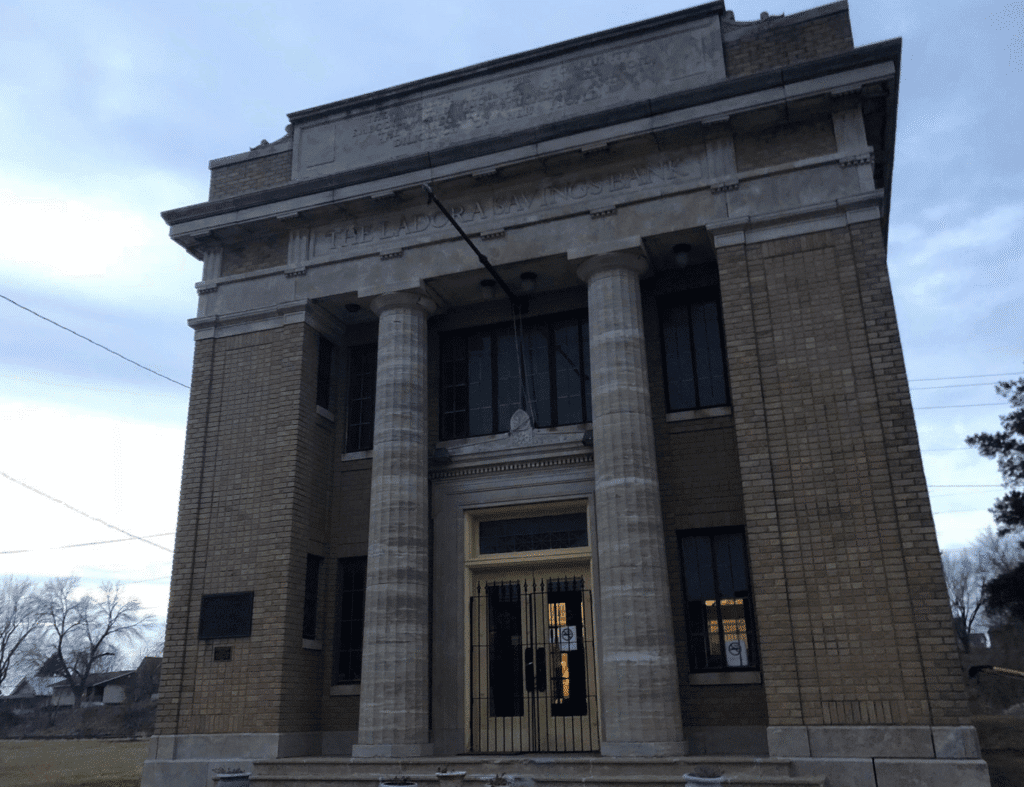
As of September 29, 2026, the Earlham Downtown Historic District is officially listed on the National Register of Historic Places! The district encompasses the small, Madison County community’s historic brick downtown, including buildings built between 1895 and 1975. Located along the Chicago, Rock Island, and Pacific Railroad, Earlham grew as a predominantly Quaker settlement and thrived as a center for shipping stone, apples, wool, and other local products along the railroad. After a fire in 1901 destroyed a block of downtown, the local government and business leaders committed to rebuilding the commercial center in brick to safeguard against future fires. Some of the buildings constructed around this time included a lavish bank (pictured below) and an opera house, something few towns Earlham’s size had at this time. The buildings are ornamented with a variety of details popular at the time, including Victorian, Romanesque, and Colonial Revival elements. Even as times changed and the railroads became less central to Iowa’s commercial landscape, Earlham adapted to serve automobile travelers on the nearby White Pole Road. New buildings in this period were more restrained and reflected changing tastes for simpler designs in the middle of the 20th century. Today, almost all of Earlham’s downtown buildings still house local businesses, and the legacy of downtown Earlham continues. #iowahistoricpreservation #IowaHistory #iowahistory
Chuck Offenburger's Come See How Jefferson Does Things.


Learning from Cemeteries: Preservation Trades Training in Burial Spaces-- Free virtual webinar Oct 20, 2026 06:00 PM (Central) Historic cemeteries provide a unique landscape for the living to learn from those that came before them. Interaction with a memorial, whether a monumental stone obelisk or a humble marker, is a shared human experience where individuals encounter and make sense of the past. Often, these experiences can serve as a gateway into the field of historic preservation. In recent years, a number of trades training initiatives (notably, the Bridge to Craft Careers Program at World Monument Fund) have offered the opportunity for interested students to explore and learn skills in historic masonry, metalwork and plasterwork in historic cemetery landscapes. This unique partnership offers exposure to immense architectural resources for students, and provides much needed support in the care and conservation of significant cultural heritage. HPEF has invited the following innovators to discuss and share their work: - Elimarie Garcia-Cosme, Global Heritage Training Manager, World Monuments Fund (WMF) - Karina Roca, Bridge to Crafts Careers Program Manager, Preservation Resource Center of New Orleans - Sara Lowenburg, Director of Save Our Cemeteries, Preservation Resource Center of New Orleans - Neela K. Wickremesinghe, Director of Restoration and Preservation at The Green-Wood Cemetery HPEF's Director of Programs, Lauren Drapala, will be moderating this free, one-hour virtual event. Register here: https://zoom.us/webinar/register/WN_nki3oYArT36kyWo7QBCC_w#/registration

Check out these tools from the National Alliance of Preservation Commissions! Tell your mayors and local government officials about the proposed changes to Section 106 . We’ve prepared resources to help: 📄 Open Letter to City Mayors and Local Government Leaders Share the letter with your local elected officials to help them understand what the proposed changes could mean for local communities. 🔗https://tinyurl.com/cbjtbnkw ✏️ Working Letter Template Customize the letter for your community by adding local priorities, concerns, and a Section 106 success story that demonstrates the value of the review process. 🔗https://tinyurl.com/3bup9krz 📧 Email Template Draft an email to introduce the issue and encourage local government leaders to learn more and engage. 🔗 https://tinyurl.com/2nhxess6 Use these resources and have a conversation with your mayor, city council, county commissioners, or other local government leaders about Section 106. It is important to bring local perspectives into the conversation. Learn more and access the all Section 106 resources through NAPC’s Advocacy Page. 🔗https://www.napcommissions.org/advocacy

From the National Trust for Historic Preservation. Last Thursday, the Vice Chair of the Advisory Council on Historic Preservation terminated the Section 106 review of the proposed Triumphal Arch at Memorial Circle, a 250-foot monument that would stand in front of Arlington National Cemetery. The review was ended before consultation was finished, and the public was given 3½ business days to comment. Section 106 exists to make sure federal agencies listen before they act. This is what it looks like when it’s set aside. This is your opportunity to provide your comments. Email Jaime Loichinger at jloichinger@achp.gov before 11:59 p.m. ET on Tuesday, September 29. Suggested subject line: Comments on the Monumental (Triumphal) Arch at Memorial Circle Write in your own words. Personal comments are more effective than form letters. You might say: · What the view between the Lincoln Memorial and Arlington National Cemetery means to you. · Express why a comment period of a few business days is not a meaningful chance to be heard on a project of this significance. · That the National Park Service acknowledged this project would adversely affect dozens of historic properties, yet alternatives, like another site, or a smaller structure, or different design, were never seriously evaluated.

PlaceEconomics recently completed an impact study of Iowa's Main Street program, now 40 years old! You can download the report yourself here: https://www.placeeconomics.com/resources/40-years-of-main-street-iowa/

Call for Nominations - Advocacy Award The Vernacular Architecture Forum seeks nominations for the VAF Advocacy Award. The VAF Advocacy Award recognizes exemplary efforts and achievements on behalf of our vernacular built heritage. The award honors individuals and groups for exceptional contributions toward the interpretation, appreciation, and protection of vernacular buildings and cultural landscapes, and recognizes outstanding initiative, commitment, and action to promote and protect vernacular resources. The deadline is December 15, 2026. Read more here: https://www.vafweb.org/Advocacy
https://www.kcrg.com/2026/09/19/it-belongs-us-historian-celebrates-ruling-over-iowa-citys-state-historical-society/


There's a remarkable preservation project underway in Mt. Pleasant! The Second Baptist Church, located at 407 West Saunders in Mount Pleasant, is the oldest African American church in Iowa. The church was originally built as a Methodist church in 1843 at another location in the city. The church was moved to its present location about 1856 to make way for the construction of the Asbury Methodist church that opened in 1857. The African American congregation was established in 1863, and the building was initially used as a school for Black children as well as a church. After Mount Pleasant voluntarily integrated its schools in 1867, the building served solely as a church, in continuous use by the Black congregation for 146 years. The church was listed on the National Register of Historic Places in 2014. So what's happening? Overtime, the foundation had become unstable so the building was lifted up so that a new foundation could be installed. And just last week, the concrete was poured into the forms. Next, the contractor will remove the forms so the walls can cure. The last step is to attach a wood sill to the top of the walls, and then the church will be lowered down and attached to the sill. This project will turn the building into a museum dedicated to and celebrating the rich African American history of Mount Pleasant. If you'd like to learn more, visit https://historicsecondbaptistmp.org/ #iowablackhistory #iowaarchitecture

If you don't already know about the preservation guidance available at the National Park Service, you'll want to check it out! NPS. has a handy A to Z index for about every preservation topic you'd need to know. Want to know about repointing brick? Check! Preservation of clay tile roofs? Got that covered! Converting schools to residential use? Yep! The link to the Preservation by Topic webpage is: https://www.nps.gov/orgs/1739/preservation-by-topic.htm