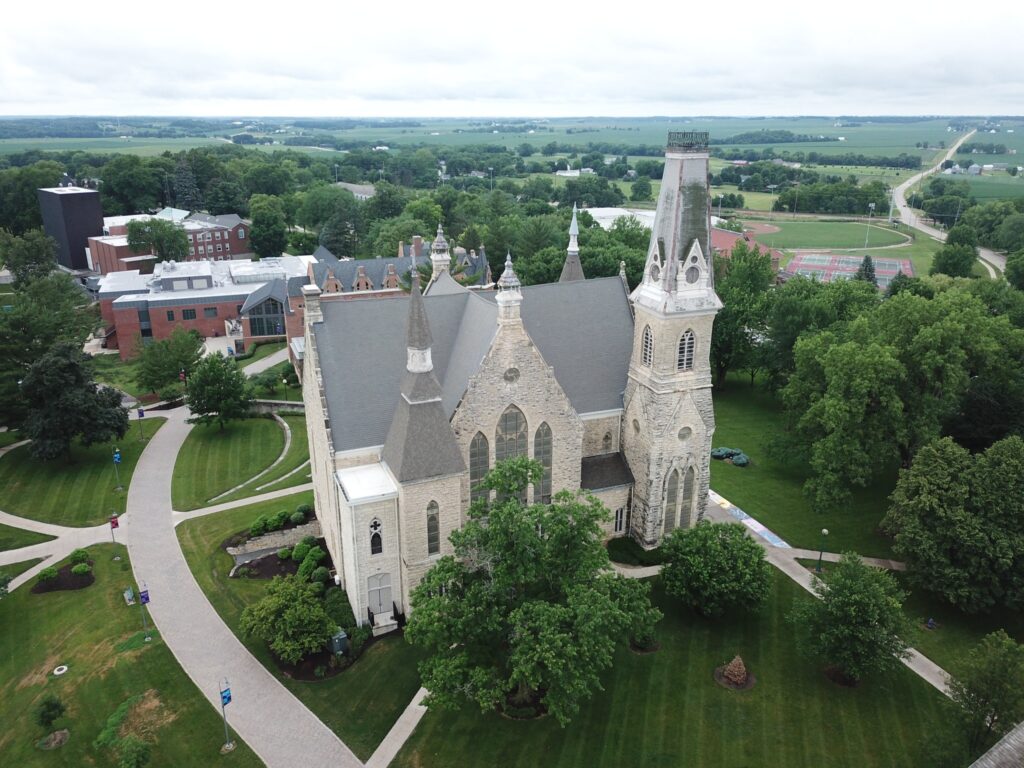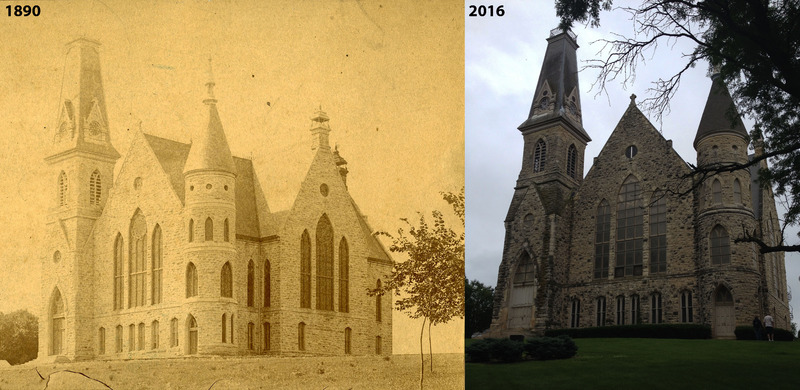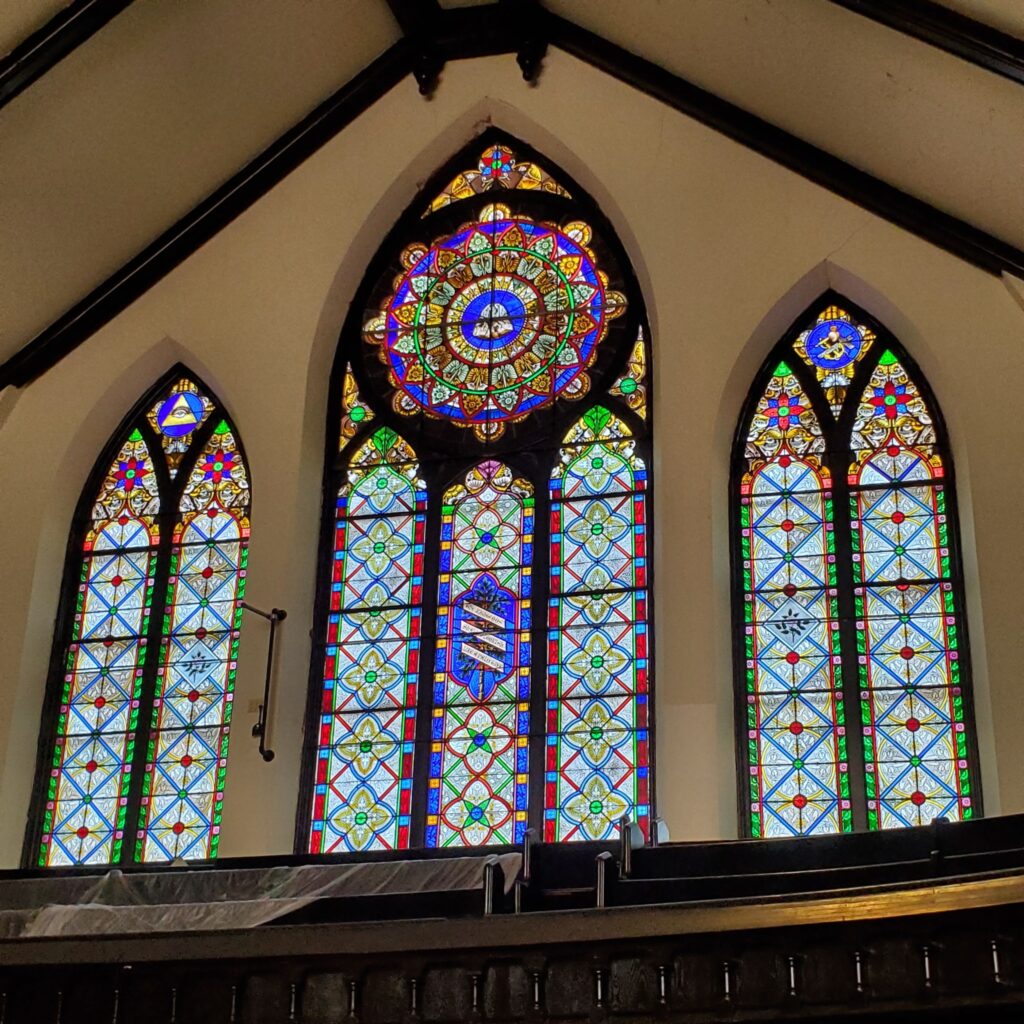
King Chapel on the campus of Cornell College has dominated the skyline of Mt. Vernon since its completion in 1882. Designed in the Victorian Gothic style by Chicago architect Cass Chapman, the building is constructed of yellow dolomite limestone quarried in nearby Stone City. It is marked by three towers the largest of which rises 130 feet and features the only remaining working Model 17 tower clock made by the Seth Thomas Clock Company. Windows throughout the building are filled with stained glass including the transom over the entry.
After its completion, King Chapel, re-named in 1940 in honor of the Cornell president who oversaw its construction, quickly became a cultural center not only for Cornell but also for the surrounding community. In addition to church services and college events, it has been host to public concerts, performances, and lectures featuring speakers like Martin Luther King Jr., Frank Lloyd Wright, and Carl Sandburg.
The chapel has undergone many renovations over the years to meet the changing needs of the campus community, but the exterior has remained largely unchanged. The chapel was named to the National Register of Historic Places in 1976 and is a key contributing structure to the Cornell College Historic District listed on the National Register in 1980.
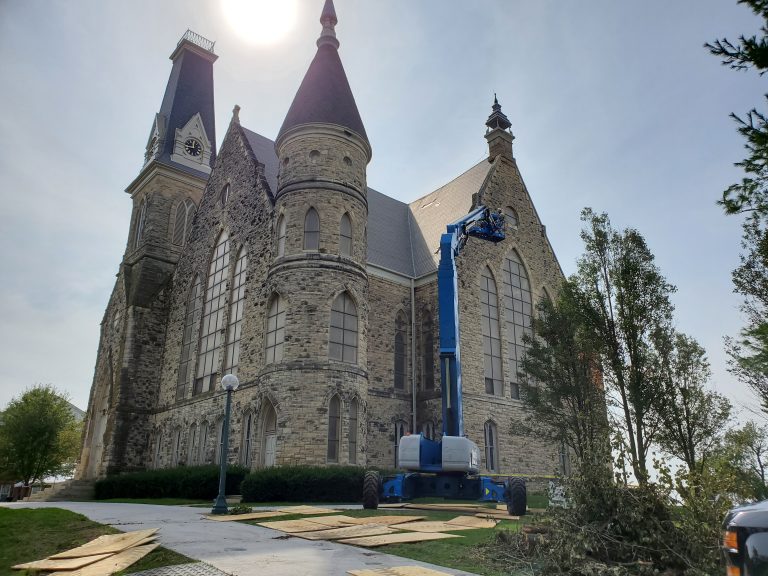
From the beginning, Cornell College has been strongly committed to the maintenance and preservation of this focal point of campus and community life. Most recently the college completed a comprehensive tower reconstruction project in 2018, including the restoration of the original Seth Thomas clock. Also, when an elevator was added to the exterior in 2015 to make the building more accessible, local limestone was used in the construction.
Cornell was forced to close the chapel, however, after high winds during the 2020 derecho that tore through Eastern Iowa caused considerable damage to the structure. Currently, the entire roof is in danger of collapsing with at least four of the support trusses fractured by the force and sustained winds of the derecho. The west wall, that took the brunt of the storm, was pushed out an estimated 8+ inches.
The financial resources needed to address and repair the identified issues will be staggering. Shouldering the cost of repairs and restoration of King Chapel will be extremely difficult for Cornell as a number of campus buildings have needed post-derecho repairs. In addition to FEMA and insurance, Cornell is making a concentrated effort to work with alumni, local foundations, the Mount Vernon Historic Preservation Commission and the State Historic Preservation Office to leverage available opportunities so repairs can be made.